City stays
Savannah on Foot, From the Squares to the River
A city laid out as twenty two small green rooms, best understood by walking a straight line through as many of them as you can and refusing to take a car anywhere.
May 24, 2026 / Savannah, Georgia / Two nights / 8 min
Savannah was laid out in the 1730s around a repeating unit: a small public square with lots arranged around it, repeated across the plan until you have a whole town made of the same tile. Twenty two of those squares survive. Almost everything worth understanding about walking here follows from that single fact.
I gave it two nights and walked about fourteen miles, which sounds like a lot and did not feel like it, because the plan of the town breaks a long walk into small pieces. You cross a square, you go two blocks, you cross another square. The distance disappears into the rhythm.
01The one thing to do first
Pick a north south street that runs through a run of squares and walk it end to end without stopping for anything.
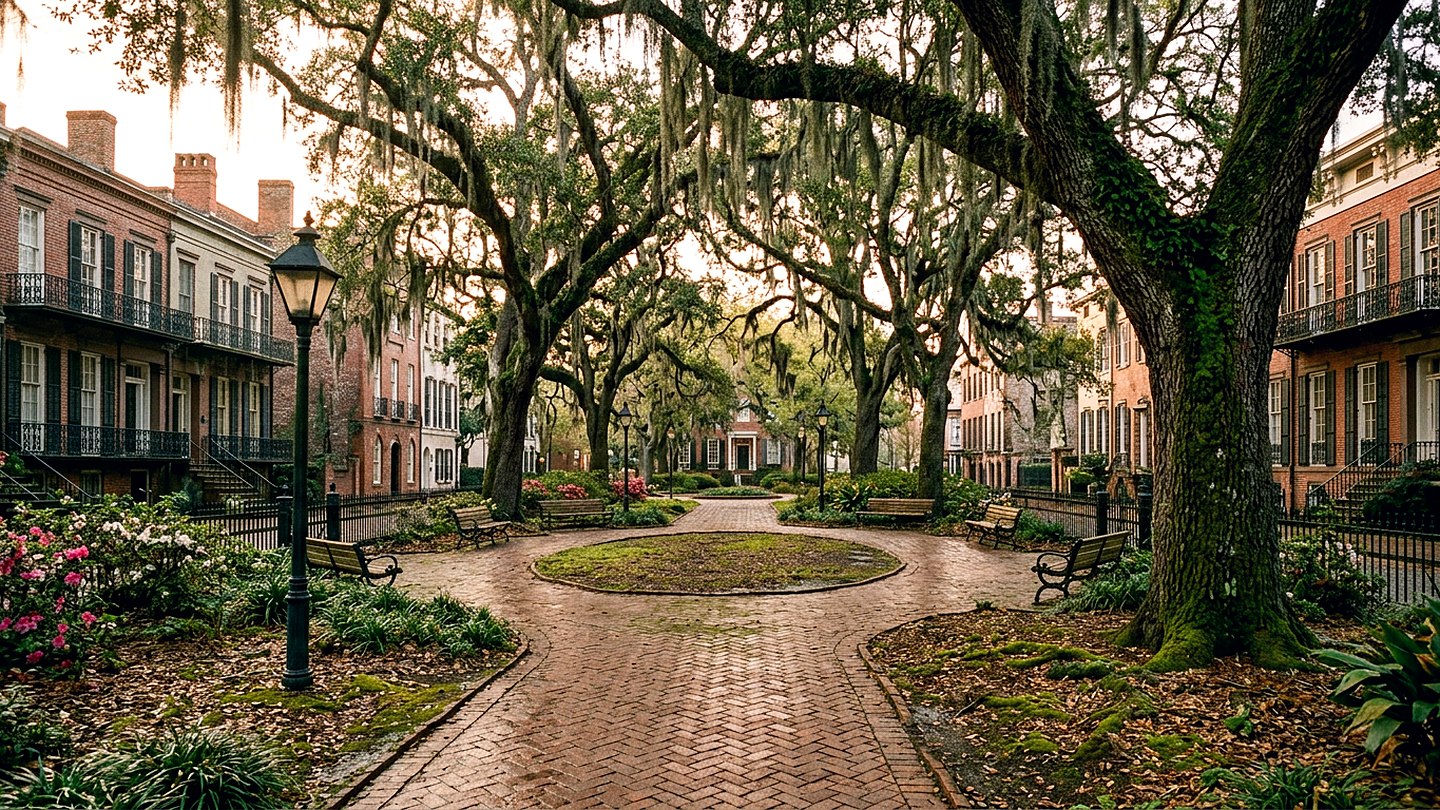
The squares are not decoration dropped into a grid. They are the grid, and walking through six of them in a row is the closest thing this city has to an instruction manual. Each one is a small green room, maybe a hundred feet across, shaded by live oaks whose branches spread horizontally rather than up. Each has its own character depending on what has been planted in it and what got built around it, and going through them in sequence teaches you the pattern in about forty minutes.
Traffic has to go around them, which is why the whole historic district is quiet in a way that a city of this size has no right to be. Cars move slowly because the plan forces them to.
The squares are not decoration dropped into a grid. They are the grid, and walking north to south through six of them in a row is the closest thing this city has to an instruction manual.
02The moss, and the hour it belongs to
The other thing everybody mentions is the moss, which hangs off the oaks in long grey grey green curtains and which is not a parasite, it is an air plant that simply lives up there.
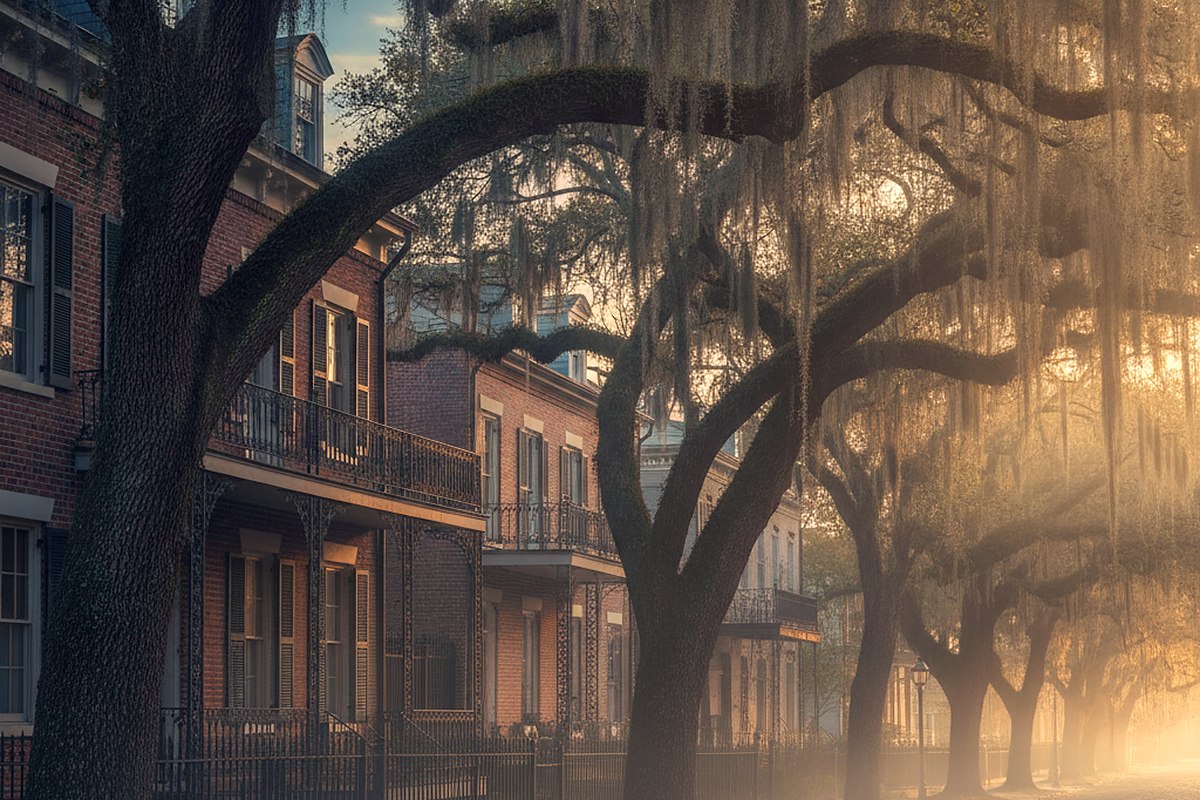
It photographs badly in the middle of the day and beautifully in the first two hours after sunrise, and the difference is not subtle. At noon it reads as grey fuzz. At seven in the morning, backlit, with mist still sitting on the ground in the larger squares, it separates into individual strands and glows. I set one early alarm on the second morning and it was the best hour of the trip by a wide margin.
Mornings are also when the historic district belongs to the people who live in it. Somebody watering. Somebody walking a dog with strong views about squirrels. A delivery van doing a three point turn around a square with the patience of long practice.
03Down at the river, and how long to give it
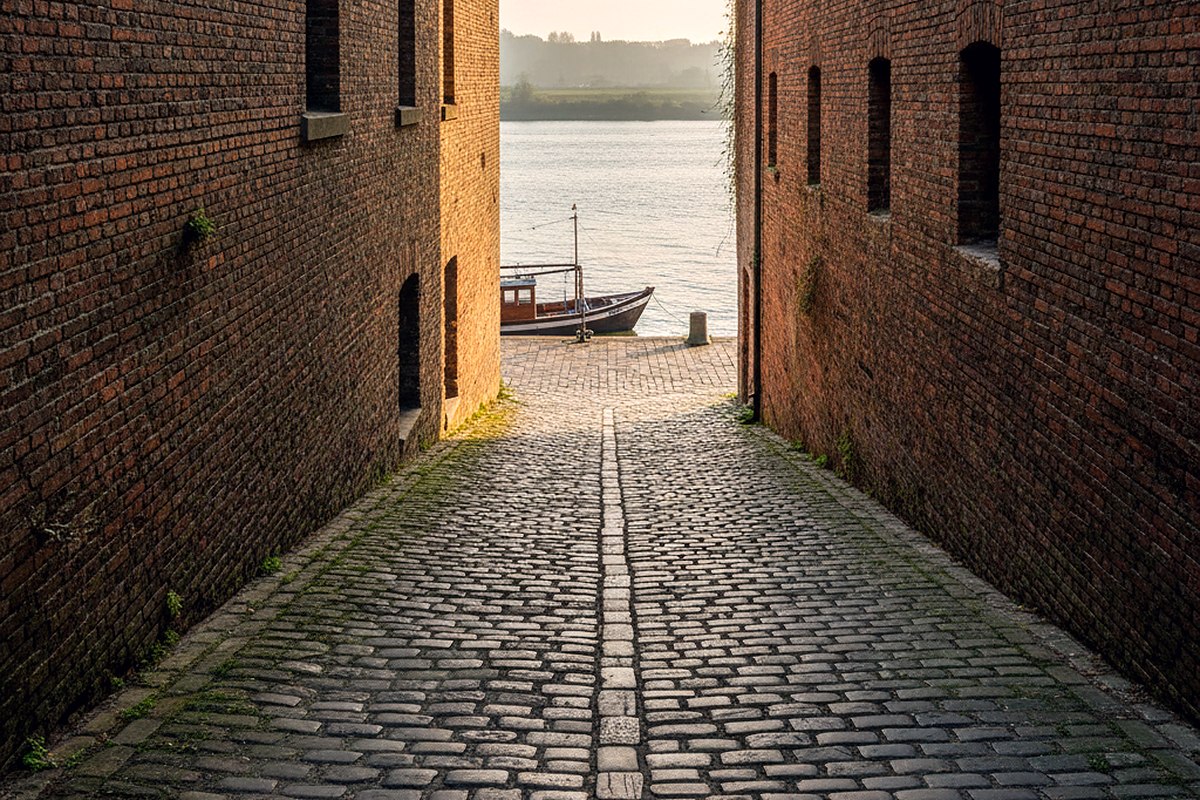
The town sits on a bluff, and at the northern edge it drops sharply to the river, connected by a set of very old, very steep cobbled ramps and stairways cut between brick warehouse walls.
Going down them is the interesting part. The stone is enormous and worn into hollows, the walls on either side are four and five storeys of old brick, and the whole thing feels engineered for a completely different century, which it was. It is also genuinely treacherous underfoot, and I would not attempt it in the rain or in anything other than flat shoes with grip.
The river level itself is a different town: touristed, loud, and mostly given over to visitors. I would give it an hour rather than an afternoon. Walk the length of it once, look at the working ships coming up the channel, which are startlingly large and pass close, then climb back up into the grid where the actual city is.
04What two nights buys you
Two nights means two mornings and two evenings, and both matter here.
The evenings are warm and slow and the squares empty out gradually rather than all at once. Around dusk the light comes horizontally down the streets between the oaks and the whole district goes gold for about fifteen minutes. I made a point of being somewhere with a long sightline for both of them.
Between the two, the middle of the second day is the flexible part. I spent mine walking the residential streets south of the busiest squares, where the houses are brick and iron and the pace drops away completely, and I would do that again over any indoor attraction. This is a city best understood from the pavement.
05Practical notes
Everything above assumes walking, and I mean that seriously. The historic district is about a mile and a half top to bottom and a mile across. A car is an obstacle: parking is metered and awkward, the squares make driving slow by design, and you will see almost nothing from inside one.
The heat is the constraint rather than the distance. In late May it was already hot by ten in the morning and humid all day, and the shade of the oaks is the reason the walking works at all. Plan the exposed stretches early, keep the middle of the day in the shaded streets, and carry more water than the mileage suggests.
Not every square is equally interesting, and there is no obligation to collect all twenty two. I walked nineteen and the three I missed have not troubled me. Pick a line, follow it, and let the town repeat itself around you.
06The honest summary
Savannah is a plan you walk through rather than a list of sights, which makes it either a very good two night city or a slightly frustrating one, depending on what you came for.
If you want to tick off attractions it will feel thin. If you are happy to spend two days walking a beautiful eighteenth century diagram in heavy shade, stopping in green rooms, and being out early enough to see it before anybody else does, it is one of the most rewarding short stays in the country. Two nights was right. Three would not have been wasted. One would have been a mistake.